How Much Exercise Does a Chihuahua Need? Plus Brain Games
General training information. Every dog is an individual; for health or behavior concerns, see your veterinarian.
A Chihuahua may fit in a handbag, but that does not mean this breed is happy doing nothing all day. Many owners are surprised by how busy a small dog can be.
This guide covers how much exercise a Chihuahua needs, how to split it up, and how to add mental work so your dog is tired in a good way. It is written as a set of steps you can follow this week.
The Short Answer
The PDSA, a UK pet charity, says a Chihuahua needs a minimum of half an hour of exercise a day. It suggests splitting that into two walks, plus play in a secure area.
Hill's Pet describes the breed as active and says these dogs like to be kept occupied, despite being lap dogs. So the picture is a small dog with a real need for movement and something to think about.
Treat half an hour as a floor, not a target for every dog. Individual dogs vary in energy, age and health, so your own Chihuahua may want more or less. Your veterinarian can tell you what suits your dog.
What You Need
You do not need much. Gather these before you start:
- A well-fitted harness and a standard leash. A harness spreads pressure across the chest instead of the neck, which is kinder for a small dog. Never use choke, prong or shock collars.
- Small, soft treats your dog loves, cut into tiny pieces. Count them as part of the daily food allowance.
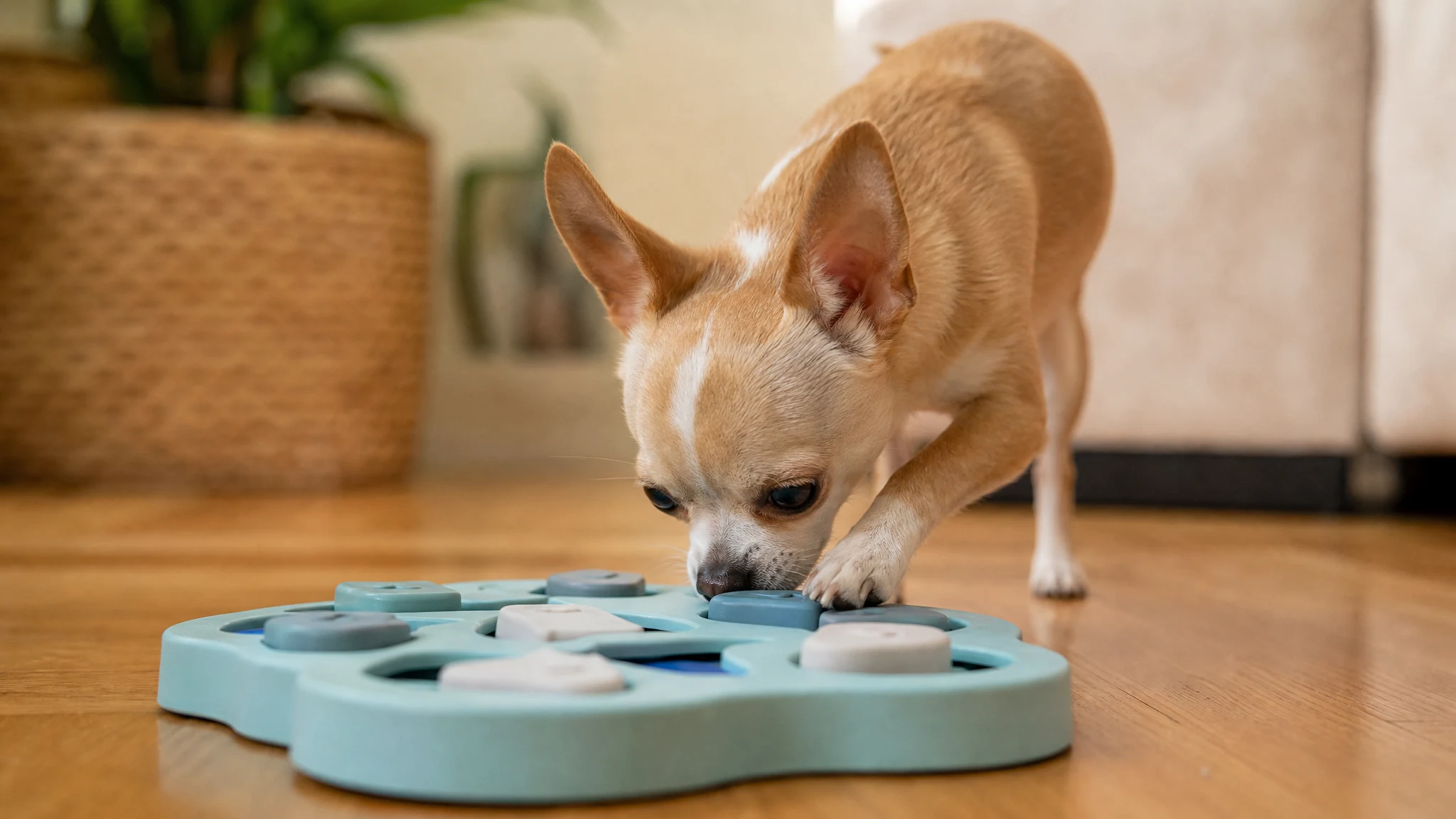
- A puzzle feeder, snuffle mat or lick mat. Any basic version works.
- A secure play area, such as a fenced yard or a dog-proofed room, for off-leash play.
- A few household items for games: cardboard boxes, a muffin tin, tennis balls or small balls, and a towel.
- A timer or phone, so you can keep sessions short.
Step 1: Check Your Dog's Health First
Before you build an exercise routine, ask your veterinarian whether your dog is ready for it. This matters for this breed in particular.
The PDSA lists luxating patellas, hip dysplasia, eye conditions, heart disease, tracheal collapse and dental problems among the health concerns for Chihuahuas. Some of these can affect how much and what kind of activity is comfortable.
Ask your vet about jumping, stairs, pace and weather limits for your dog. We do not give medical advice here, and only a vet can say what is safe for your individual dog.
Step 2: Set a Daily Movement Baseline
Start with the PDSA guideline of at least half an hour a day, split across two walks. A simple plan looks like this:
- Morning walk of about 15 minutes at an easy pace.
- Evening walk of about 15 minutes or longer.
- Play in a secure area, such as indoor fetch with a soft ball or a short chase game.
If your dog is new to walking, begin with shorter outings and build up over a couple of weeks. Watch your dog rather than the clock. Heavy panting, slowing down, lagging behind or sitting down mid-walk are signs to stop and rest.
Puppies and Joints
Puppies are a special case. The sources available to us do not give a specific puppy exercise limit for Chihuahuas, so we will not make up a number of minutes.
Ask your veterinarian how much and what kind of exercise suits a growing puppy, and how to protect young joints. In the meantime, keep play gentle, avoid repeated jumping off furniture, and let your puppy rest when they want to.
Adults and Seniors
Adult dogs can usually follow the baseline above. For older dogs, the PDSA says Chihuahuas live for over 12 years, and Hill's gives a somewhat higher figure, so you may share many years with your dog. As your dog ages, check with your vet about adjusting the length and pace of walks. Mental games become even more useful when physical exercise needs to be gentler.
Step 3: Turn Walks Into Sniff Walks
A sniff walk is about letting your dog explore with their nose instead of marching to a destination. It adds mental work to the exercise you are already doing.
- Pick a calm, safe route, ideally with grass, trees or other interesting smells.
- Clip the leash to a harness and let the leash hang loose.
- Stop when your dog stops to sniff. Give them a minute or two before you gently move on.
- Let your dog choose the direction at some intersections, as long as it is safe.
- Reward calm behavior with a small treat, for example when your dog checks in with you.
A 20-minute sniff walk may cover less ground than a brisk one, but many owners find their dogs seem more settled afterward. Results vary from dog to dog.
Keep in mind that the PDSA reports snapping at strangers or small children as a known challenge in the breed. On busy walks, give your dog space, and do not let strangers grab or swoop in. A quiet route is often easier for a small dog.
Step 4: Add Puzzle Feeders at Mealtimes
Feeding from a bowl takes seconds. A puzzle feeder can turn part of your dog's daily food into a ten-minute task.
- Start with the easiest option, such as a lick mat or a simple snuffle mat.
- Put in part of a meal, not extra food. This keeps weight in check.
- Let your dog work it out without help. Step in only if they seem stuck or frustrated.
- Once your dog is quick at it, move to a harder puzzle.
- Wash the feeder regularly so it stays clean.
You can also make a simple version at home: scatter dry food across a towel, roll it up loosely and let your dog unroll it. Supervise, and remove any toy or material your dog starts to chew apart.
Step 5: Play Short Training Games
Training is mental exercise. The PDSA says Chihuahuas need consistency and respond to reward-based methods with a firm but fair approach. It also says to socialize them from a young age.
The sources we have do not describe a specific original working job for the breed, so we will not tie these games to one. The Chihuahua Club of America breed standard does describe the temperament as alert, with terrier-like attitudes of self-importance, confidence and self-reliance. These games suit an alert, confident dog who likes to be busy.
Game 1: Find the Treat
- Ask your dog to wait, or have someone hold them gently.
- Hide a few treats in easy spots around one room.
- Say a cue such as "find it" and let your dog search.
- Praise as they find each treat. Make hiding spots harder over time.
Game 2: The Muffin Tin Shuffle
- Place a treat in several cups of a muffin tin.
- Cover each cup with a tennis ball, or a small ball sized so your dog cannot swallow it.
- Let your dog work out how to move the balls to reach the treats.
Game 3: Name the Toy
- Choose two toys and give each a name.
- Say a name, point to the toy and reward when your dog touches it.
- Practice for a few minutes, then add a second toy and ask for one by name.
Game 4: Short Tricks and Manners
Sit, down, spin, touch and come when called are all good brain work. Keep each session to about five minutes, end on a success and use tiny treats. For a full plan on building these skills, see our guide on how to train a Chihuahua.
Step 6: Build a Daily Rhythm
Put it all together in a simple routine. Here is a sample day you can adjust:
| Time | Activity | Type |
|---|---|---|
| Morning | About 15 minute walk | Physical, plus light sniffing |
| Breakfast | Puzzle feeder or lick mat | Mental |
| Midday | 5 minute training game | Mental |
| Afternoon | Play in a secure area | Physical |
| Evening | Sniff walk of 15 minutes or more | Physical and mental |
| After dinner | Find the treat or toy naming | Mental |
On rainy days, swap a walk for extra indoor games. Mental work can make up for some missed outdoor time, though it is not a full replacement for movement, so aim to get your dog out most days.
Tips for Success
- Keep sessions short. Several short bursts tend to work better than one long one for a small dog.
- Use a harness. Many small dogs are comfortable in one, and it avoids pressure on the neck. Ask your vet about this, since the PDSA lists tracheal collapse among the breed's health concerns.
- Stay consistent. The PDSA notes the breed needs consistency, so use the same cues and the same rules every day.
- Rotate toys and puzzles. Put some away and bring them back later so they feel new.
- Watch the treat count. Small dogs have small daily food allowances, so subtract training treats from meals.
- Practice being alone. The PDSA lists difficulty being left alone as a known challenge. Give your dog a lick mat or puzzle and leave for short periods, then slowly extend them.
Common Mistakes to Avoid
- Assuming a lap dog needs no exercise. Hill's calls the breed active, and the PDSA gives a daily minimum.
- Skipping the vet check. Joint, heart, airway and eye concerns can change what is safe.
- Allowing risky jumps. Repeated leaping off couches and beds is hard on small legs. Use ramps or steps and ask your vet for advice.
- Using punishment when your dog barks or snaps. Hill's says the breed may bark more than some larger dogs. Shock, prong and choke collars, alpha rolls and scruffing are not part of humane training, and the American Veterinary Society of Animal Behavior (AVSAB) supports reward-based methods. Try to work out what triggers the behavior, then reward calmer choices.
- Long, hard sessions. A bored or overtired dog gets frustrated. Stop while your dog is still enjoying it.
- Leaving off-leash play unsupervised. Even a secure area needs an adult watching a very small dog.
- Ignoring the weather. Heat and cold can be hard on small dogs. Ask your vet what limits fit your dog.
What Results to Expect
Every dog is different, and we cannot promise any outcome. Still, many owners find that a regular mix of walks, play and brain games may help a dog settle more easily at home. Over a few weeks you may notice your dog seems calmer in the evening, more interested in training, or less likely to invent their own entertainment.
Mental exercise may also help with boredom-related barking, though barking has many causes. If barking, snapping or distress when left alone is serious or getting worse, talk to your veterinarian, who can rule out health causes and may refer you to a qualified behavior professional.
A Note on Puppy Soft Spots
Many Chihuahua puppies are born with a molera, a soft spot on top of the head, and about as many are born without one. The Chihuahua Club of America says a molera does not mean a medical problem. If you are unsure about your puppy's soft spot, or you want guidance on safe handling and play, ask your veterinarian.
Putting It Into Practice
Start small. Add one sniff walk and one puzzle feeder this week. Next week, add a short training game. Track how your dog responds, adjust to their energy and age, and check in with your vet whenever you are unsure.
A Chihuahua who gets regular movement and something to figure out is often an easier companion at home. For next steps, our complete guide to training a Chihuahua walks through the basics in order.